Burger King Dessert Prices
A creamy vanilla soft-serve cup or a slice of crunchy HERSHEY’S® Sundae Pie is the perfect ending to a flame-grilled meal at Burger King. The cheapest item on the Burger King dessert menu with prices is the Chocolate Chip Cookie, starting at $1.99 in many locations. The most expensive individual treat is the Burger King OREO® Shake, which reaches $5.99 or more in some locations.
Burger King menu prices 2026
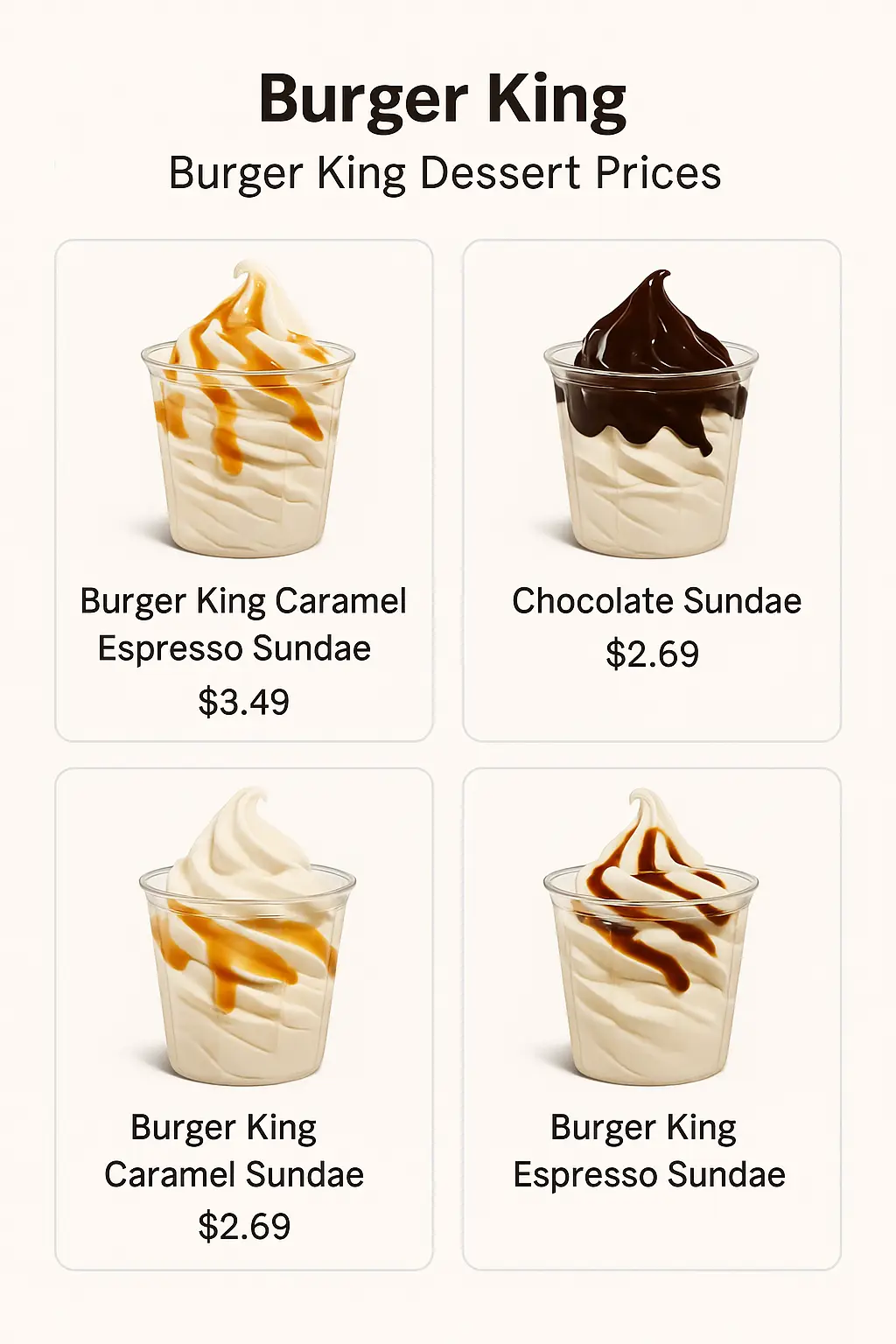
How much is a Burger King Caramel Espresso Sundae?
The Burger King dessert prices for a Caramel Espresso Sundae range from $3.49 to $4.19. This treat features velvety vanilla soft serve swirled with buttery caramel and a bold espresso-flavored syrup. A Caramel Espresso Sundae costs $3.49 in residential markets, while the price increases in high-rent city locations.
How much is a Burger King Chocolate Sundae?
For a HERSHEY’S® Chocolate Sundae, Burger King dessert prices sit between $2.69 and $3.19. This dessert consists of creamy soft serve topped with authentic Hershey’s chocolate syrup. A Chocolate Sundae costs $2.69 in Houston, whereas the price rises to $3.19 in Los Angeles.
How much is a Burger King Caramel Sundae?
The Burger King dessert prices for a Caramel Sundae range from $2.69 to $3.19. This selection pairs the signature vanilla soft serve with a warm, thick caramel topping. A Caramel Sundae costs $2.69 in Houston, but the price reaches peak levels at high-cost urban storefronts.
How much is a Burger King Espresso Sundae?
A Burger King Espresso Sundae carries a price tag between $3.49 and $4.59 on the Burger King dessert menu with prices 2026 guide. It provides a caffeinated twist on the classic sundae by adding a rich coffee-infused syrup to the soft serve base. An Espresso Sundae costs $3.49 in most standard regions, while the price rises in busier urban areas.
How much is a Burger King BK Sundae with Nutella?
A BK Sundae with Nutella on the latest Burger King dessert prices list range from $3.99 to $4.79. This premium item features a generous swirl of Nutella hazelnut spread over cold, velvety soft serve. This specialty item costs $3.99 at participating promotional locations, while the price increases in premium metropolitan stores.
How much is a Burger King soft serve cone?
Individual Burger King dessert prices for a soft serve cone or cup range from $1.99 to $2.39. This 190-calorie dessert is the foundational item of the sweets menu and is served freshly poured into a wafer cone or a convenient cup. A soft serve cup costs $1.99 in Houston, but the price rises to $2.39 in Los Angeles.
How much is a Burger King Coke float?
The Burger King dessert prices for a Coke float range from $3.49 to $4.59. This nostalgic treat combines bubbly Coca-Cola with a scoop of creamy vanilla soft serve for a refreshing dessert beverage. A Coke float costs $3.49 in residential markets, while the price increases at high-rent metropolitan locations.
How much is a Burger King root beer float?
Selecting a root beer float results in Burger King dessert prices between $3.49 and $4.59. This version uses Barq’s® Root Beer mixed with velvety soft serve for a thick and spicy flavor profile. A root beer float costs $3.49 at promotional locations, but the price reaches higher points in busier metropolitan areas.
How much is a Burger King apple pie?
The cost for a Cinnamon Apple Pie on the Burger King dessert menu is between $2.39 and $2.89. This fried pastry features a golden crispy crust and a warm cinnamon-infused apple filling. An apple pie costs $2.39 in Houston, while the price rises to $2.89 in Los Angeles.
How much is a Burger King banana pie?
The Burger King dessert prices for a Banana Pie range from $2.49 to $3.49. This limited-edition or regional item offers a tropical fruit filling inside the signature flaky crust. A banana pie costs $2.49 at participating locations, whereas the price increases in high-cost urban centers.
How much is a Burger King taro pie?
The cost of a slice of Taro Pie on Burger King dessert prices range from $2.49 to $3.49. Known for its vibrant purple filling and subtly sweet, nutty taste, this item is typically found in select international or promotional markets. A taro pie costs $2.49 in residential areas, while the price rises at premium metropolitan stores.
How much is a Burger King King Fusion (Oreo / Nutella / seasonal flavors)?
The Burger King dessert prices for a King Fusion range from $4.29 to $5.49. While often replaced by hand-spun shakes in the US, this item provides a thick blend of soft serve and heavy mix-ins like OREO® pieces or seasonal candies. A King Fusion costs $4.29 in residential locations, whereas the price reaches peak levels at high-cost urban storefronts.
How much is a Burger King seasonal pie or limited dessert item?
Burger King dessert prices for seasonal items like the Firecracker Cookie Pie range from $3.59 to $3.89. These limited-time offerings feature unique ingredients and holiday-themed decorations to attract dessert seekers. A Firecracker Cookie Pie costs $3.59 in Houston, while the price rises to $3.89 in Miami.
Burger King Dessert Prices by Year
Chronological tracking of Burger King dessert prices illustrates the brand's transition from 50-cent cones to a menu focused on premium branded collaborations. Historically, the dessert section was anchored by the one-dollar value tier, which featured individual cookies and small sundaes for over a decade. The introduction of the Hershey’s Sundae Pie and hand-spun shakes established new, higher price levels for the sweets category. Yearly adjustments now reflect the rising costs of dairy processing and the logistics of sourcing branded ingredients. The table below lists the chronological price changes for these treats.
| Year (Index) | Name | Price |
|---|---|---|
| 2021 | Caramel Espresso Sundae | $2.99 |
| 2021 | Chocolate Sundae | $2.19 |
| 2021 | Caramel Sundae | $2.19 |
| 2021 | Espresso Sundae | $2.99 |
| 2021 | BK Sundae with Nutella | $3.49 |
| 2021 | Soft Serve Cone | $1.49 |
| 2021 | Coke Float | $2.99 |
| 2021 | Root Beer Float | $2.99 |
| 2021 | Apple Pie | $1.99 |
| 2021 | Banana Pie | $2.09 |
| 2021 | Taro Pie | $2.09 |
| 2021 | King Fusion | $3.69 |
| 2021 | Firecracker Cookie Pie | $1.99 |
| 2022 | Caramel Espresso Sundae | $3.09 |
| 2022 | Chocolate Sundae | $2.29 |
| 2022 | Caramel Sundae | $2.29 |
| 2022 | Espresso Sundae | $3.09 |
| 2022 | BK Sundae with Nutella | $3.59 |
| 2022 | Soft Serve Cone | $1.59 |
| 2022 | Coke Float | $3.09 |
| 2022 | Root Beer Float | $3.09 |
| 2022 | Apple Pie | $2.05 |
| 2022 | Banana Pie | $2.15 |
| 2022 | Taro Pie | $2.15 |
| 2022 | King Fusion | $3.79 |
| 2022 | Firecracker Cookie Pie | $3.09 |
| 2023 | Caramel Espresso Sundae | $3.19 |
| 2023 | Chocolate Sundae | $2.39 |
| 2023 | Caramel Sundae | $2.39 |
| 2023 | Espresso Sundae | $3.19 |
| 2023 | BK Sundae with Nutella | $3.69 |
| 2023 | Soft Serve Cone | $1.69 |
| 2023 | Coke Float | $3.19 |
| 2023 | Root Beer Float | $3.19 |
| 2023 | Apple Pie | $2.15 |
| 2023 | Banana Pie | $2.25 |
| 2023 | Taro Pie | $2.25 |
| 2023 | King Fusion | $3.89 |
| 2023 | Firecracker Cookie Pie | $3.19 |
| 2024 | Caramel Espresso Sundae | $3.29 |
| 2024 | Chocolate Sundae | $2.49 |
| 2024 | Caramel Sundae | $2.49 |
| 2024 | Espresso Sundae | $3.29 |
| 2024 | BK Sundae with Nutella | $3.79 |
| 2024 | Soft Serve Cone | $1.79 |
| 2024 | Coke Float | $3.29 |
| 2024 | Root Beer Float | $3.29 |
| 2024 | Apple Pie | $2.25 |
| 2024 | Banana Pie | $2.35 |
| 2024 | Taro Pie | $2.35 |
| 2024 | King Fusion | $3.99 |
| 2024 | Firecracker Cookie Pie | $3.29 |
| 2025 | Caramel Espresso Sundae | $3.39 |
| 2025 | Chocolate Sundae | $2.59 |
| 2025 | Caramel Sundae | $2.59 |
| 2025 | Espresso Sundae | $3.39 |
| 2025 | BK Sundae with Nutella | $3.89 |
| 2025 | Soft Serve Cone | $1.89 |
| 2025 | Coke Float | $3.39 |
| 2025 | Root Beer Float | $3.39 |
| 2025 | Apple Pie | $2.29 |
| 2025 | Banana Pie | $2.39 |
| 2025 | Taro Pie | $2.39 |
| 2025 | King Fusion | $4.15 |
| 2025 | Firecracker Cookie Pie | $3.45 |
| 2026 | Caramel Espresso Sundae | $3.49 |
| 2026 | Chocolate Sundae | $2.69 |
| 2026 | Caramel Sundae | $2.69 |
| 2026 | Espresso Sundae | $3.49 |
| 2026 | BK Sundae with Nutella | $3.99 |
| 2026 | Soft Serve Cone | $1.99 |
| 2026 | Coke Float | $3.49 |
| 2026 | Root Beer Float | $3.49 |
| 2026 | Apple Pie | $2.39 |
| 2026 | Banana Pie | $2.49 |
| 2026 | Taro Pie | $2.49 |
| 2026 | King Fusion | $4.29 |
| 2026 | Firecracker Cookie Pie | $3.59 |
Price levels for the Burger King dessert menu are dictated by the market value of dairy and the licensing fees for premium brand names. Unlike burgers, the dessert section is highly sensitive to the energy costs required for constant deep-freezing.
- Dairy Commodity Market: Fluctuations in the wholesale price of milk and heavy cream directly impact the production cost of the liquid soft-serve base.
- Energy and Utility Rates: Operating industrial-grade soft-serve machines and commercial blast freezers 24 hours a day makes local electricity rates a major factor.
- Branded Ingredient Licensing: Incorporating name-brand components like Oreo, Hershey’s, and Nutella involves licensing costs that are reflected in the final retail price.
- Logistics of Perishables: Maintaining a strict cold-chain supply for frozen pies and liquid dairy requires specialized transportation that adds to the menu overhead.
- Franchise Management: Independent owners set specific local Burger King dessert prices to cover city-specific expenses such as property rent and local labor laws.
Historical benchmarks for the Burger King dessert prices list were notably lower in the previous decade. Between 2012 and 2016, a standard soft serve cone was a staple for under $1.50 in many residential markets. Data from PriceListo shows that the baseline moved toward the three-dollar mark as the brand introduced larger portions and premium branded pies. Recent records confirm that as dairy and sugar expenses have increased, the average baseline for a hand-spun dessert has reached the $5.00 range.
The most substantial growth occurred in the Burger King dessert prices for hand-spun shakes and specialty cookie pies. Statistical data indicates that a standard chocolate shake moved from a national average under $3.00 in 2014 to rates that exceed $5.50 today. This trend is caused by the rising wholesale costs of refined sugar and the higher labor expenses involved in manual blending. Branded pies have also seen sharp increases due to the rising market price of premium cocoa and chocolate chips.
Value-conscious diners usually choose the Chocolate Chip Cookie or the standard soft serve cup, which have remained the most affordable options. These items serve as the foundational entry points for the Burger King sweets menu, allowing the brand to offer a predictable cost for budget-focused families. By maintaining high efficiency with these high-volume products, Burger King can keep these price points more stable than the rotating seasonal or premium branded alternatives.
Why do Burger King prices vary by location?
Variations in local Burger King dessert prices happen because independent operators must set rates that align with their specific economic liabilities. A Burger King restaurant in a high-density urban center faces rent and utility burdens that are significantly higher than those of a rural standalone location. These economic variances, combined with state-specific minimum wage laws for staff who manage the dessert machines, force price adjustments to ensure profitability across diverse markets.
Burger King's Prices — Houston
Current average prices as of October 2026
| Item | Price (USD) |
|---|---|
| Caramel Espresso Sundae | $3.49 |
| Chocolate Sundae | $2.69 |
| Caramel Sundae | $2.69 |
| Espresso Sundae | $3.49 |
| BK Sundae with Nutella | $3.99 |
| Soft Serve Cone | $1.99 |
| Coke Float | $3.49 |
| Root Beer Float | $3.49 |
| Apple Pie | $2.39 |
| Banana Pie | $2.49 |
| Taro Pie | $2.49 |
| King Fusion | $4.29 |
| Firecracker Cookie Pie | $3.59 |
Burger King's Prices — Los Angeles
Current average prices as of October 2026
| Item | Price (USD) |
|---|---|
| Caramel Espresso Sundae | $4.19 |
| Chocolate Sundae | $3.19 |
| Caramel Sundae | $3.19 |
| Espresso Sundae | $4.19 |
| BK Sundae with Nutella | $4.79 |
| Soft Serve Cone | $2.39 |
| Coke Float | $4.09 |
| Root Beer Float | $4.09 |
| Apple Pie | $2.89 |
| Banana Pie | $2.99 |
| Taro Pie | $2.99 |
| King Fusion | $5.09 |
| Firecracker Cookie Pie | $4.19 |
Burger King's Prices — Jacksonville
Current average prices as of October 2026
| Item | Price (USD) |
|---|---|
| Caramel Espresso Sundae | $3.95 |
| Chocolate Sundae | $2.99 |
| Caramel Sundae | $2.99 |
| Espresso Sundae | $3.95 |
| BK Sundae with Nutella | $4.49 |
| Soft Serve Cone | $2.29 |
| Coke Float | $3.79 |
| Root Beer Float | $3.79 |
| Apple Pie | $2.69 |
| Banana Pie | $2.79 |
| Taro Pie | $2.79 |
| King Fusion | $4.79 |
| Firecracker Cookie Pie | $3.95 |
Burger King's Prices — Miami
Current average prices as of October 2026
| Item | Price (USD) |
|---|---|
| Caramel Espresso Sundae | $3.89 |
| Chocolate Sundae | $2.95 |
| Caramel Sundae | $2.95 |
| Espresso Sundae | $3.89 |
| BK Sundae with Nutella | $4.45 |
| Soft Serve Cone | $2.25 |
| Coke Float | $3.75 |
| Root Beer Float | $3.75 |
| Apple Pie | $2.65 |
| Banana Pie | $2.75 |
| Taro Pie | $2.75 |
| King Fusion | $4.69 |
| Firecracker Cookie Pie | $3.89 |
Burger King's Prices — New Jersey
Current average prices as of October 2026
| Item | Price (USD) |
|---|---|
| Caramel Espresso Sundae | $3.69 |
| Chocolate Sundae | $2.85 |
| Caramel Sundae | $2.85 |
| Espresso Sundae | $3.69 |
| BK Sundae with Nutella | $4.19 |
| Soft Serve Cone | $2.15 |
| Coke Float | $3.65 |
| Root Beer Float | $3.65 |
| Apple Pie | $2.55 |
| Banana Pie | $2.65 |
| Taro Pie | $2.65 |
| King Fusion | $4.49 |
| Firecracker Cookie Pie | $3.75 |
Burger King's Prices — Atlanta
Current average prices as of October 2026
| Item | Price (USD) |
|---|---|
| Caramel Espresso Sundae | $3.59 |
| Chocolate Sundae | $2.79 |
| Caramel Sundae | $2.79 |
| Espresso Sundae | $3.59 |
| BK Sundae with Nutella | $4.09 |
| Soft Serve Cone | $2.09 |
| Coke Float | $3.59 |
| Root Beer Float | $3.59 |
| Apple Pie | $2.49 |
| Banana Pie | $2.59 |
| Taro Pie | $2.59 |
| King Fusion | $4.39 |
| Firecracker Cookie Pie | $3.69 |
Yes, financial shifts in the national economy impact the Burger King dessert prices on an annual basis to reflect the pressure on the food industry. Official reports confirm that the company implements price updates to counteract the increasing costs of fuel for refrigerated distribution and the energy needed for constant freezing. These adjustments ensure that the brand can continue to provide high-quality dairy and branded ingredients without compromising its business standards.
Supply chain volatility for milk, cream, and refined sugar directly influences the final Burger King dessert prices displayed on the menu. When the market price of liquid dairy or the logistics of distributing frozen pies becomes more expensive, these costs are eventually passed to the consumer. Operators must also manage the seasonal costs of fruit for limited-time pies, which can lead to monthly shifts in the profitability of the sweets section.
Yes, limited time offers on the Burger King app are a common way for fans to save on the standard Burger King dessert prices. Members of the Royal Perks program frequently receive "offers" that allow them to purchase a sundae or cookie for a discounted rate or as a free add-on to a meal. Furthermore, national marketing events may temporarily lower the cost of specific dessert bundles to drive traffic during family dining hours or holiday seasons.
Yes, dessert prices are lower when purchased as part of a "meal upgrade" substitution rather than as standalone items. Burger King occasionally offers promotions where a sundae can be added to a combo for a lower total rate than if purchased as a separate transaction. This strategy provides better value for diners who want to include a sweet treat with their flame-grilled meal.
Fees on third-party platforms cause a notable inflation in the Burger King dessert prices for those ordering from home. Services like DoorDash or UberEats typically apply a 15 to 30 percent markup on every dessert before adding separate service and delivery fees. This makes a standard shake or pie order much more expensive for the customer than visiting a physical restaurant or using the Burger King drive-thru.
What are the Other Menus of Burger King?
Burger King segments its overall catalog into several categories like Burger King Breakfast Menu Prices and Burger King Chicken & Fish Prices. Each category features its own unique pricing structure and seasonal variations. The following list details the other specific menus available at Burger King restaurants.